Anthropic has launched Claude Fable 5, its first Mythos class model accessible to the general public.
On benchmarks, the model impresses. It dominates its predecessors on code, autonomous agents, long-context tasks, and complex reasoning.
But this launch mostly reveals a deeper evolution of the market: the most powerful models are no longer simple endpoints that we call directly.
They arrive with safety rules, fallback mechanisms, domain restrictions, specific retention policies, and sometimes access differences depending on the client's profile.
Raw power is no longer enough. The real issue becomes control.
Fable 5 and Mythos 5: same base, different access
Anthropic offers two models from the same performance class.
Claude Fable 5 is the public version. It is available via the classic API and integrates strict safety guardrails.
Claude Mythos 5 remains reserved for a more restricted circle: cybersecurity partners, validated organizations, and certain trusted access programs.
Anthropic indicates that both models are based on the same technical foundation, but that Mythos 5 benefits from lighter protections in certain domains.
The difference therefore does not only relate to performance.
It relates to the level of access, the applied restrictions, and the actually authorized uses.
For an end user, this can remain abstract.
For an API platform, a model router, or an agent system, it's a central element.
Automatic fallback: the real change
Fable 5 does not work exactly like a classic endpoint.
When a request touches domains considered sensitive — cybersecurity, biology, chemistry, or certain high-risk subjects — safety classifiers can intervene.
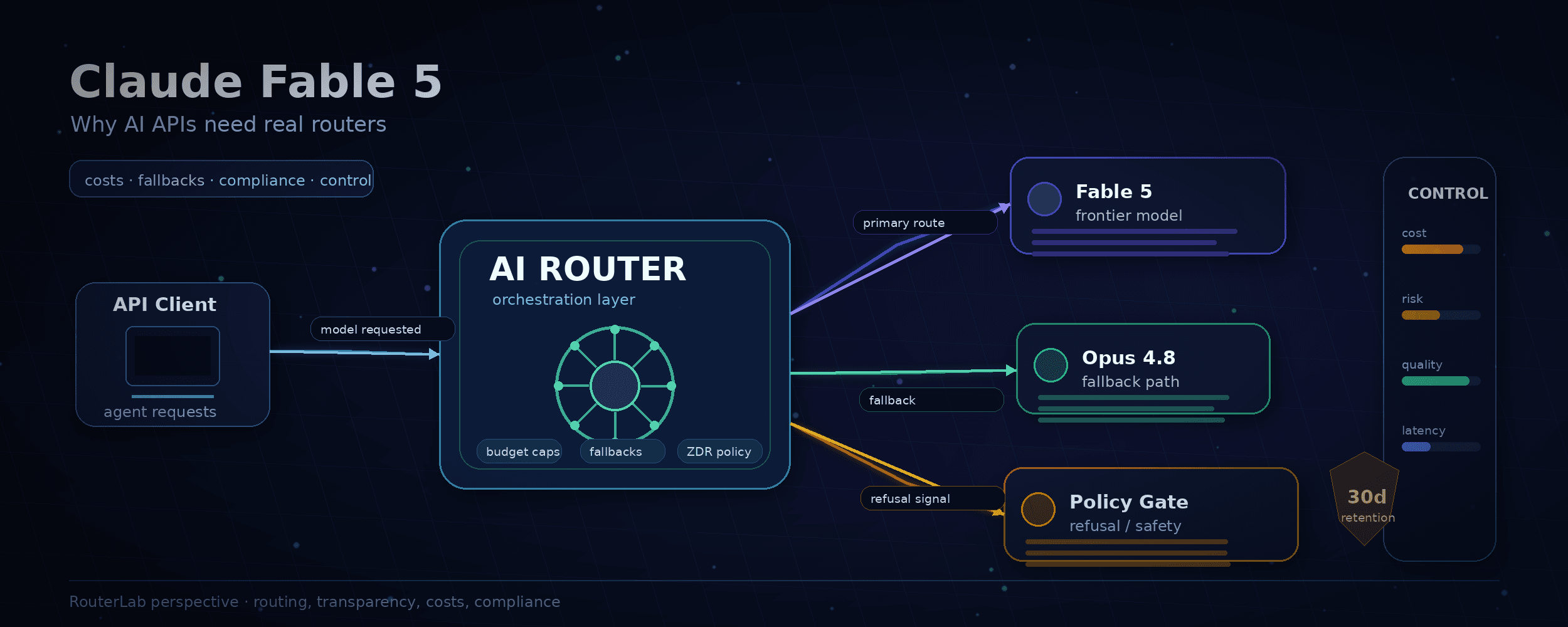
Depending on the channel, configuration, or fallback options, this can lead to an explicit refusal or a redirection to Claude Opus 4.8.
Anthropic's goal is understandable: to avoid a total blockage by providing a response via a model considered less risky.
But for integration and user experience, this mechanism poses a concrete problem.
The application or the developer thinks they are using Fable 5.
However, depending on the subject, they may receive a response produced by another model, or obtain a refusal that they must handle correctly on the application side.
This is not necessarily a problem if it's transparent.
It becomes a problem if the developer, the application, or the end client does not clearly understand what happened.
False positives and conservative launch
Anthropic admitted having set the guardrails very conservatively in order to allow a rapid public release.
This choice has a cost: false positives.
Some legitimate requests concerning biology, immunology, or scientific research can trigger redirections or refusals.
A normal scientific question can be interpreted as sensitive by the classifiers, even when it has no offensive character.
After the initial feedback, Anthropic began to improve the transparency of refusals and redirections.
This is a positive step.
But it does not eliminate the underlying problem: frontier models are no longer static systems.
Their behavior now depends on classifiers, safety policies, fallback rules, and sometimes the client's access level.
The cost: power vs profitability
Fable 5 is billed at $10 per million input tokens and $50 per million output tokens.
This is twice the price of Opus 4.8.
On critical and complex tasks, this price can be justified. If the model can solve a difficult problem, avoid errors, or reduce working time, the cost can remain acceptable.
But for autonomous agents, correction workflows, and iterative development, the situation is different.
An agent does not make a single request.
It reads files, plans, writes code, corrects, tests, analyzes errors, starts again.
At this rate, an inefficient routing strategy can turn a productivity gain into a cost that is difficult to control.
The question is therefore no longer just:
What is the best model?
The real question becomes:
What model to use for this specific task, with what level of control over cost, behavior, and compliance?
Benchmarks vs production reality
Benchmarks remain useful.
They allow us to measure progress and compare models on standardized tasks.
But they are no longer sufficient to evaluate a model in real conditions.
A model can dominate the rankings while being unpredictable in production due to fallbacks, refusals, or changes in behavior depending on the domain.
Conversely, a slightly less powerful but stable, traceable, and predictable model can prove to be more interesting operationally.
For an API platform, what really matters is not just the raw score.
What matters is the relationship between:
- the actual quality of the response;
- the cost per completed task;
- the fallback rate;
- the refusal rate;
- the stability of the behavior;
- the transparency of the model actually used;
- the retention policy;
- compliance with client constraints.
A very powerful but hard-to-predict model can become less profitable than a slightly less powerful, but better-mastered model.
Orchestration becomes essential
For simple usage, a fallback to another model may remain acceptable.
For a professional API, it's insufficient.
A platform that exposes several models must be able to know precisely:
- which model was requested;
- which model actually responded;
- if a fallback or a refusal occurred;
- why this fallback or refusal took place;
- what retention policy applies;
- what rate should be billed;
- what message should be displayed to the end user.
Without this control layer, the API becomes opaque.
And in a professional infrastructure, opacity breaks trust.
A client paying for Fable 5 must be able to understand when they are actually using Fable 5, when another model takes over, and why.
They must also be able to control their budget and prevent autonomous agents from consuming credits without visibility.
Data retention and European constraints
Anthropic applies a 30-day retention on the API traffic of Fable 5 and Mythos class models.
This data is used for safety and not for training new models.
From a security standpoint, this approach can be defended: detecting abuse, analyzing complex attacks, tracking jailbreaks, improving guardrails.
But for European organizations subject to strict confidentiality, data sovereignty, or Zero Data Retention requirements, this is a sensitive point.
Here again, the technically most powerful model is not always the most suitable.
The right model depends on the usage context, the budget, the acceptable level of risk, and contractual obligations.
Security or access segmentation?
Anthropic justifies these restrictions with security imperatives.
This explanation is partly valid.
A highly capable model cannot be made available without guardrails on sensitive topics like offensive cybersecurity, certain biological tasks, or model distillation.
But when two versions of the same technical base coexist with different levels of restriction depending on the client profile, we also observe a form of access segmentation.
Some users benefit from fewer limitations than others.
This phenomenon is not new, but it is becoming much more visible with frontier models.
It reinforces the need for platforms to understand the actual conditions of use of the models they offer.
What API platforms must implement
The most advanced models increasingly arrive with variable conditions of use.
For API platforms, this requires building a real orchestration layer capable of:
- intelligently routing according to the type of task;
- explicitly managing fallbacks;
- tracking the model actually used;
- detecting and explaining refusals;
- applying the right retention policies;
- controlling costs per task;
- avoiding useless retry loops;
- providing transparency to end users.
This is exactly the role of a modern AI router.
A router should not just send a request to the most powerful model.
It must choose the right model, at the right time, at the right price, with the right level of transparency.
Conclusion
Claude Fable 5 is an impressive model.
But its launch primarily illustrates the next phase of the AI market: more powerful, more expensive, more filtered, and more complex to properly integrate models.
The question is no longer just whether Fable 5 is better than Opus 4.8, a current GPT model, or Gemini 3.1 Pro.
The real question is how to build an infrastructure capable of using these models without losing control over costs, compliance, and user experience.
For end users, Fable 5 is a new model.
For developers and API platforms, it's a clear signal.
The days of simply picking a model from a list are disappearing.
The future belongs to platforms capable of intelligent routing, tracking behaviors, and guaranteeing the client what they are actually using.
With Fable 5, Anthropic is not just showing a more powerful model.
It is showing that raw power is no longer enough.
The real product, from now on, is control.
Try the RouterLab API
Move from the article to a real request: start a trial, get a key, and call models through an OpenAI-compatible API.