Introduction: The Era of AI Agents That Act
In January 2026, two open-source projects exploded on GitHub and transformed how we think about AI assistants: OpenClaw (formerly Clawdbot then Moltbot) and Memu.bot. These two solutions embody a revolution: that of autonomous AI agents that no longer just respond, but act for you, 24/7.
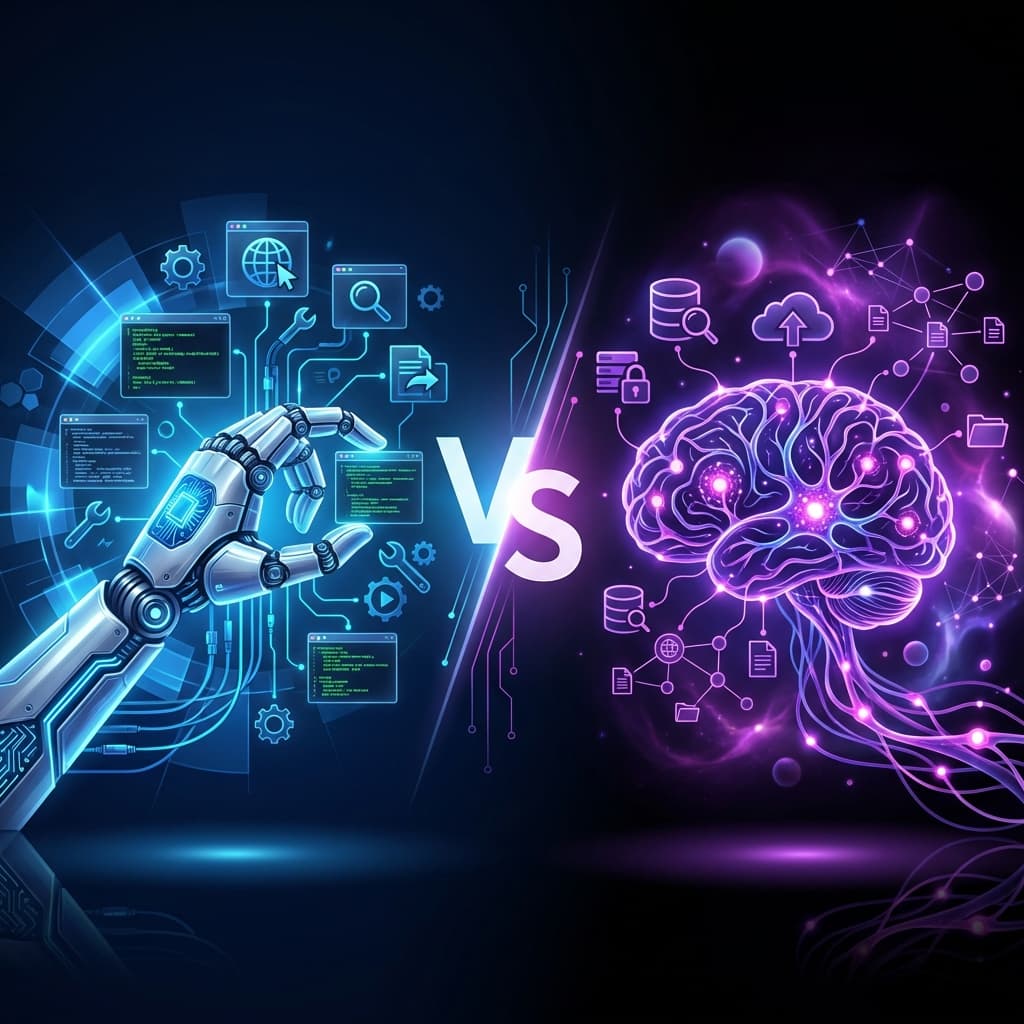
But behind this common promise lie two radically different philosophies. OpenClaw is the action agent: it controls your browser, executes system commands, manages your emails and calendar. Memu is the memory agent: it understands your intentions, anticipates your needs, and acts proactively through persistent, evolving memory.
This article provides an in-depth comparison of these two architectures to help you choose the one that fits your needs.
Part 1: OpenClaw — The Agent That Controls Your Computer
What is OpenClaw?
OpenClaw is a personal AI assistant that runs locally on your machine (Mac, Windows, or Linux) and integrates with your favorite messaging apps: WhatsApp, Telegram, Discord, Slack, Signal, or iMessage.
The promise: "AI that actually does things."
Concretely, OpenClaw can:
- ✅ Clear your inbox and respond to emails
- ✅ Manage your calendar and check you in for flights
- ✅ Navigate the web and fill out forms
- ✅ Execute shell commands and scripts
- ✅ Read and write files on your system
- ✅ Create its own "skills" (capabilities) based on your needs
Technical Architecture
Node.js Runtime: OpenClaw functions as a daemon (background service) that stays active 24/7.
Skills System: Extensible via community plugins or created by the agent itself. You can ask "Learn to use the Notion API" and the agent will:
- Read the documentation
- Write the integration code
- Create a reusable skill
- Use it immediately
With ClawHub, the community registry now features over 3,000 skills as of February 2026, covering use cases ranging from DevOps to daily automation.
Browser Control: Uses Chrome DevTools Protocol (CDP) to control a real browser, click buttons, and extract data.
Full System Access: Can execute any command with your user privileges ("Full Access" mode) or be restricted in a Docker sandbox ("Sandboxed" mode).
OpenClaw's Strengths
✅ Raw power: Can automate almost anything a human can do on a computer
✅ Multi-platform integration: Works with 50+ applications (Gmail, GitHub, Spotify, Obsidian, etc.)
✅ Active community: 150,000+ GitHub stars (February 2026), rapidly growing skills ecosystem
✅ Persistent memory: Remembers your preferences and becomes unique to you
✅ Open-source: Accessible code, local hosting, total control
OpenClaw's Weaknesses
⚠️ Explosive API costs: Users report bills of $50 to $500/month, even $3,600 in extreme cases (Federico Viticci, MacStories)
⚠️ Security risks: A Cisco audit in January 2026 revealed malware in popular skills. Full system access can be dangerous if misconfigured.
⚠️ Technical complexity: CLI installation, Docker configuration, managing multiple API keys
⚠️ Token consumption: Each action requires reasoning loops (Chain-of-Thought) that multiply costs
Ideal Use Cases
- DevOps and automation: Deployments, automated tests, server management
- Complex web scraping: Data extraction from modern sites (React/Vue)
- Extreme productivity: Email management, calendar, repetitive tasks
- Developers: Creating custom workflows, API integrations
Part 2: Memu — The Agent That Understands and Anticipates
What is Memu?
Memu (memU) is a memory framework for autonomous AI agents. Unlike OpenClaw which focuses on action, Memu focuses on understanding and anticipation.
The promise: "Memory for proactive 24/7 agents that work for you, even while you sleep."
Release: memU 1.0.0 was released on January 5, 2026, establishing a new foundation for production-scale AI agent workflows.
Concretely, Memu enables:
- 🧠 Intent prediction: Understands what you want before you ask
- 🧠 Persistent memory: Remembers everything, across sessions, days, months
- 🧠 Proactive actions: Acts autonomously based on detected patterns
- 🧠 Cross-session continuity: Picks up a conversation from 5 days ago as if it were yesterday
Technical Architecture: The 3-Layer Memory Engine
Memu uses a unique hierarchical architecture:
1. Resource Layer
Ingestion of raw data: conversations, audio, images, videos, logs.
2. Memory Item Layer
Extraction of structured atomic facts:
- Todo: "Follow up with Sarah Chen in 2h"
- Intent: "Likely searching for enterprise pricing info"
- Pattern: "Active between 9-11am, maximum engagement time"
- Action: "Sent proactive discount, churn avoided"
3. Memory Category Layer
Automatic organization into semantic files:
intention.md: Real-time intent predictionstodo.md: Pending tasks with contextcomplete.md: Success historyfailure.md: Learning from errorssuccess.md: Wins and winning patterns
Intent Prediction: The Key Innovation
Memu continuously analyzes user behavior to predict intentions:
Concrete example (from Memu.pro site):
User: Sarah Chen
Session: Active for 12 minutes
Confidence: 94%

Predicted intents:
• Primary: Seeking enterprise pricing info (94%)
  Evidence: Visited pricing page 3x, hovered "Enterprise" tab
  Suggested action: Proactively offer custom quote

• Secondary: Evaluating team onboarding (78%)
  Evidence: Downloaded team setup guide, searched "bulk invite"
  Suggested action: Share team admin tutorial

• Emerging: Considering API integration (62%)
  Evidence: Brief visit to API docs, technical profile
  Suggested action: Prepare integration examples
The agent can then act before the user asks anything.
Memu's Strengths
✅ Optimized costs: 90% reduction in token consumption through dynamic context loading
✅ Evolving memory: Learns continuously, improves over time
✅ Proactivity: Anticipates needs, acts autonomously
✅ Perfect continuity: Picks up any conversation, even after months
✅ Impressive benchmarks: 92.09% average accuracy on Locomo dataset (better than competitors)
✅ Flexible APIs: Response API (all-in-one) or Memory API (granular control)
Memu's Weaknesses
⚠️ Fewer direct actions: Doesn't control browser or system like OpenClaw
⚠️ Memory focus: Excellent for understanding and anticipating, less for executing complex system tasks
⚠️ Younger ecosystem: Fewer plugins and integrations than OpenClaw
Ideal Use Cases
- Personal assistants: Knowledge management, second brain
- Customer support: Agents that remember entire customer history
- Educational agents: Tutors that adapt to student pace
- Mental health agents: Longitudinal tracking with emotional memory
- Smart CRM: Churn prediction, proactive upsell
Part 3: Direct Comparison
Comparison Table
| Dimension | OpenClaw | Memu |
|---|---|---|
| Philosophy | Action-first ("Do things") | Memory-first ("Understand and anticipate") |
| Runtime | Node.js (Local daemon) | Python + pgvector (Cloud or local) |
| Typical cost | $50-500/month (token burn) | $5-50/month (optimized) |
| System control | ✅ Complete (shell, browser, files) | ❌ Limited |
| Memory | ✅ Persistent, contextual | ✅✅ Hierarchical, evolving, proactive |
| Intent prediction | ❌ No | ✅✅ Yes (core system) |
| Security | ⚠️ High risks (root access) | ✅ Privacy-by-design |
| Setup complexity | ⚠️ High (CLI, Docker) | ✅ Medium (pip install) |
| Integrations | ✅✅ 50+ apps (WhatsApp, Gmail, etc.) | ✅ LLM APIs (OpenAI, Anthropic, etc.) |
| Community | ✅✅ 150K+ GitHub stars | ✅ Growing |
| Open-source | ✅ Yes (MIT) | ✅ Yes (Apache 2.0) |
Cost Comparison: Why Such a Difference?
OpenClaw consumes enormous amounts of tokens because:
- Reasoning loops: Each action requires Plan → Observe → Act → Verify
- Context stuffing: Sends entire history + all skill definitions with each request (30k+ tokens)
- Premium models: Optimized for Claude Opus ($5/1M tokens input) or GPT-5 ($1.25/1M tokens input)
Example: "Find my last PDF" can require 10 internal round-trips = 50k tokens = $0.25-0.75
Memu optimizes drastically because:
- Dynamic loading: Surgically selects relevant memory fragments (2-5k tokens instead of 30k)
- Insight caching: Once information is understood and stored, no need to reread source documents
- Hybrid retrieval: Fast vector search for simple queries, LLM only for complex reasoning
Result: 90% cost reduction for equivalent functionality.
Which Solution to Choose?
Choose OpenClaw if:
- ✅ You're a developer or technical power user
- ✅ You need to automate complex system tasks
- ✅ You want an agent that controls your browser, emails, calendar
- ✅ You're ready to manage security risks and API costs
- ✅ You want a rich ecosystem of community plugins (3,000+ skills)
Typical use case: DevOps, web automation, extreme productivity
Choose Memu if:
- ✅ You're building a personal assistant or smart chatbot
- ✅ You need long-term memory and cross-session continuity
- ✅ You want an agent that anticipates your needs proactively
- ✅ You're looking to optimize API costs (tight budget)
- ✅ You're developing a SaaS product requiring user memory
Typical use case: Customer support, smart CRM, educational assistant, knowledge management
Part 4: The Infrastructure Behind Agents
The API Cost Problem
Whether you choose OpenClaw or Memu, you're going to consume tokens. Lots of tokens.
The traditional pay-as-you-go model (OpenAI, Anthropic direct) was designed for chatbots, not autonomous agents:
- Chatbot: 10-20 messages/day, 1-2k tokens/message → $5-10/month
- Autonomous agent: 100-500 API calls/day, 10-50k tokens/task → $50-500/month
The problem isn't the models, it's the pricing structure.
The RouterLab Solution: Fixed Pricing and European Sovereignty
RouterLab offers a different model: fixed monthly pricing with generous API credits, hosted on Swiss and German infrastructure.
Plans and Credits
| Plan | Monthly cost | API Credits | Ideal for |
|---|---|---|---|
| 🥉 Bronze | $9 | $15 | Personal projects and testing |
| 🥈 Silver | $19 | $40 | Freelancers and regular usage |
| 🥇 Gold | $39 | $85 | Higher-volume workloads |
| Pro | $99 | $250 | Intensive agents and premium models |
| Business | $199 | $550 | Teams and expanded capacity |
Current pricing and conditions are available on the RouterLab pricing page.
Impact for AI Agents
For OpenClaw:
- Before (Anthropic direct): 100M tokens/month @ $5/1M = $500/month
- After (RouterLab Gold): $39/month → $85 credits = controlled capacity, capped costs
- Advantage: Predictable budget, never a surprise bill
For Memu:
- Before (OpenAI direct): 20M tokens/month @ variable
- After (RouterLab Bronze): $9/month → $15 credits = controlled budget
- Advantage: Optimized costs, stress-free experimentation
European Infrastructure Benefits
Beyond costs, European hosting (Switzerland/Germany) brings:
✅ Native GDPR compliance: Data never leaves EU, no exposure to US CLOUD Act
✅ Optimized latency: 10-50ms (EU → Switzerland) vs 150-200ms (EU → US East Coast)
✅ Freedom to experiment: With a fixed cap, test without fear of surprise bills
✅ OpenAI compatibility: Integration in 2 lines of code
# Simply change the base URL
client = openai.OpenAI(
    api_key="your-routerlab-key",
    base_url="https://api.routerlab.ch/v1"
)

# Use any model
response = client.chat.completions.create(
    model="claude-sonnet-4.5",  # or gpt-5, llama-3, etc.
    messages=[{"role": "user", "content": "Hello!"}]
)
Conclusion: Two Complementary Tools
OpenClaw and Memu are not direct competitors, but complementary tools for different needs.
OpenClaw is the armed force: powerful, versatile, capable of acting on the digital world with almost total freedom. But this power comes at a price: high costs, security risks, technical complexity.
Memu is the second brain: intelligent, proactive, capable of understanding and anticipating your needs through evolving memory. More economical, safer, but less action-oriented.
Future Vision: Convergence
In the medium term, we'll likely see convergence:
-
OpenClaw will need to integrate more efficient memory mechanisms (potentially using Memu as a plugin) to survive its costs.
-
Memu will need to adopt action capabilities (via standards like MCP) to become truly agentic.
Meanwhile, these two projects define the exciting frontier of modern computing: that of autonomous AI agents working for us, 24/7.
Resources
OpenClaw:
- GitHub: github.com/openclaw/openclaw
- Official site: openclaw.ai
Memu:
- GitHub: github.com/NevaMind-AI/memU
- Official site: memu.pro
Infrastructure for AI Agents:
- RouterLab: routerlab.ch — Unified AI API, Swiss hosting, fixed pricing
- Free trial: routerlab.ch/trial
Article published on February 3, 2026 on the RouterLab blog.
Try the RouterLab API
Move from the article to a real request: start a trial, get a key, and call models through an OpenAI-compatible API.