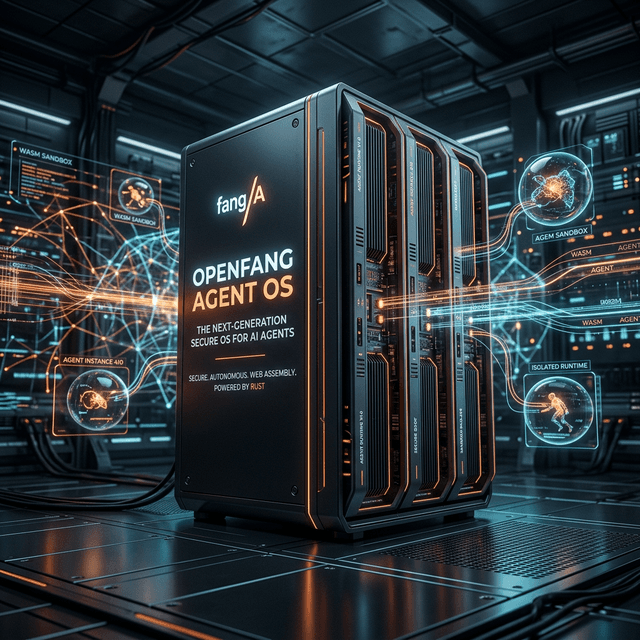
The AI agent development ecosystem has long remained a house of cards: fragile Python scripts, dependency conflicts, and "chatbot wrappers" disguised as autonomous systems. In early 2026, RightNow AI (known for its GPU engineering tools) changed the game with OpenFang.
Goodbye to unstable orchestrators. OpenFang is a true Agent Operating System (Agent OS) compiled into a monolithic 32MB Rust binary.
Here is a technical deep dive into the architecture that is redefining software autonomy.
1. A Rust Monolith Secured by WebAssembly (WASM)
The choice of Rust immediately eliminates entire classes of memory vulnerabilities. But the real challenge of an Agent OS is executing AI-generated code (which is inherently unpredictable) without compromising the host.
OpenFang isolates execution within an extremely strict Wasmtime sandbox, protected by a Dual Metering mechanism to counter the Halting Problem and DoS attacks:
- Fuel Metering (Deterministic): Each WASM instruction consumes a "fuel budget" (1,000,000 units by default). If the budget is exhausted (e.g., an infinite mathematical loop), the execution crashes instantly (
Trap::OutOfFuel). - Epoch Interruption (Temporal): A watchdog thread wakes the system every 30 seconds. If the execution exceeds its deadline (e.g., an infinite network wait), it is terminated (
Trap::Interrupt).
Furthermore, every native system spawn undergoes a preemptive env_clear(), ensuring that no host API keys are accidentally exfiltrated.
2. 16-Layer Security Model (Defense-in-Depth)
Older frameworks were like sieves when it came to prompt injections. OpenFang deploys an enterprise-grade security architecture:
Capability-Based Security
Access to resources (files, network, spawning sub-agents) is never global. It requires presenting a cryptographic token in memory (SystemCapability, NetworkCapability, etc.). When spawning a child agent, formal validation prevents any privilege escalation.
Taint Tracking (Lattice Model)
The Rust compiler and runtime collaborate to track data flows. External data is "tainted" with labels like ExternalNetwork or UserInput. If a critical function (such as shell_exec()) receives a variable bearing these labels, the execution is blocked. The taint information is mathematically preserved during any string concatenation.
Immutable Audit Trail
Every critical action is logged in a Merkle Hash Chain. Each log entry contains a UUID, a timestamp, and a cryptographic hash linked to the previous entry. Any ex post facto alteration modifies the hash tree and becomes mathematically visible.
3. The "Hands" Paradigm: Proactive Autonomy
OpenFang abandons reactivity. The user does not "talk" to the agent. The agents, called Hands, are pre-compiled packages that wake up via Cron schedules to execute specific jobs in the background.
Their behavior is locked down by two files:
HAND.toml: A rigid manifest defining authorized tools, token limits, and environment variables.SKILL.md: A knowledge base and strict algorithmic "playbook," preventing the conceptual drift (mode collapse) of LLMs.
The system natively embeds 7 production-ready Hands:
| Hand Name | Business Objective | Technical Methodology | Success Metric |
|---|---|---|---|
| Lead | Lead generation | Web enrichment, 0-100 scoring, ICP graphs | Qualified CSV/JSON volume |
| Researcher | Fact-checking | CRAAP methodology, APA formatting | Hallucination-free reports |
| Collector | OSINT | Continuous monitoring, sentiment analysis | Alert rapidity |
| Predictor | Superforecasting | Signal aggregation, chains of evidence | Brier score tracking |
| Clip | Video editing | Asynchronous FFmpeg pipeline, 5 STT engines | Vertical content published |
| Community management | Scheduling, brand voice maintenance | Engagement tracking | |
| Browser | Web automation | Playwright steering, cookie persistence | Human approval required |
4. Deployment: Powerful, but Demanding
The deployment is designed for DevOps. A simple command initializes the daemon:
curl -fsSL https://openfang.sh/install | sh
openfang init
openfang start
The system natively supports 26 LLM providers (OpenAI, Anthropic, Groq, DeepSeek), 40 communication channels (Slack, Telegram), and integrates its own asynchronous SMTP/IMAP engine to read and send emails without relying on costly third-party APIs.
⚠️ Pitfalls to Avoid in Production
Despite its power, OpenFang isn't magic. Our field tests reveal a few crucial limitations:
- The danger of state destruction: An autonomous agent blindly modifying the file system can corrupt your repositories. Solution: Impose a textual disambiguation process and a human approval barrier (Human-in-the-loop) for any destructive or financial action.
- The instability of Local LLMs: Quantized models running under Ollama massively fail to respect the strict JSON schemas required by the OS. Robust cloud models are (for now) essential in production.
- The learning curve: Writing a LangChain script is easy. Coding a new Skill for OpenFang requires mastering Taint Tracking and Rust systems engineering.
Conclusion
OpenFang marks the end of the "hacked-together chatbot" era and the beginning of industrial autonomy. By enforcing strict memory limits, cryptographic traceability, and secure asynchronous execution, this 32MB binary foreshadows what enterprise standard architecture will look like by the end of the decade.
Try the RouterLab API
Move from the article to a real request: start a trial, get a key, and call models through an OpenAI-compatible API.