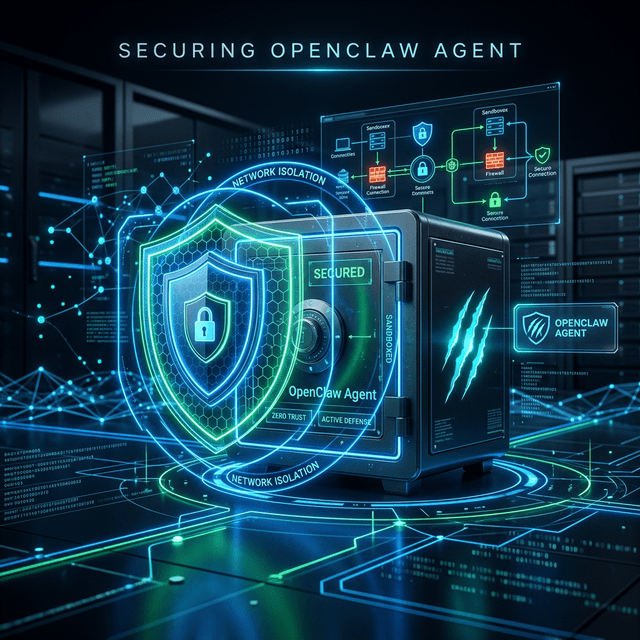
How to transform a massively deployed AI agent framework into a resilient and strictly isolated local infrastructure.
TL;DR: The era where AIs were merely text generators is over. OpenClaw operates as a local orchestration daemon with real system access. The recent "Clawjacked" vulnerability proved that blind trust in localhost is deadly. To secure your instance: isolate it on a dedicated VPS, use Tailscale, configure strict Docker sandboxing, and ban "Elevated Mode".
In February 2026, the AI ecosystem crossed a threshold with the massive adoption of OpenClaw (formerly Clawdbot). Unlike cloud-hosted LLMs, OpenClaw is a local daemon (Gateway) that orchestrates a "ReAct" (Reasoning and Acting) loop.
The agent is equipped with digital "hands": it can execute shell scripts, modify files, and communicate on Slack or Discord. But this deep system integration turns our threat model upside down. A compromise of the agent now translates to a total compromise of the host.
The Wake-Up Call: The Clawjacked Vulnerability (CVE-2026-25253)
The Clawjacked vulnerability, discovered in early 2026, perfectly illustrates the danger. By default, OpenClaw listened on 127.0.0.1:18789. The architectural error? Assuming that all local loopback traffic is legitimate.
Because browser CORS policies do not block WebSockets to localhost, it was enough for a developer to visit a malicious website for a JavaScript script to silently open a connection to the agent, force authentication in milliseconds, and take control of the machine (a "one-click" RCE).
Although patched, this flaw reminds us of a golden rule: never consider the local interface a secure zone.
4 Steps to Armor Your OpenClaw Instance
Whether you host OpenClaw for personal projects on your homelab or in a corporate environment, here are the mandatory practices to put in place.
1. Physical and Zero-Trust Network Segregation
Never run an autonomous agent with write access on your daily driver machine.
- Isolate: Use a dedicated VPS or a strict VM.
- Deprivilege: Create a standard system user (
openclaw-user) with absolutely no sudo rights. - Hide the instance: Change the default port (e.g.,
48921) and never expose it to the internet. Use Tailscale (based on WireGuard) to make your node invisible publicly.
# Launching the Gateway on a modified port, listening only on the Tailscale IP
openclaw gateway --port 48921 --bind 100.x.y.z
2. The Docker Sandboxing Trap
Most users think they are safe by enabling OpenClaw's Docker integration. This is false. By default, the mode: "non-main" setting only isolates secondary sessions, leaving the main agent to run directly on the host.
For true security, modify your ~/.openclaw/openclaw.json:
{
  "sandbox": {
    "mode": "all",
    "scope": "session",
    "workspaceAccess": "none",
    "network": "none"
  }
}
Technical Note: By cutting off the network (
"network": "none") and workspace access ("workspaceAccess": "none"), you prevent the agent from exfiltrating data via curl requests if it falls victim to a prompt injection.
3. Ban "Elevated Mode"
OpenClaw's architecture offers a conceptual backdoor: Elevated mode. Activated via /elevated on, it allows the exec tool to deliberately bypass the Docker container to execute with host privileges.
This is heresy in production. Using this mode fundamentally nullifies the benefits of confinement and must be prohibited via the Tool Policy.
4. Continuous Audit and Allowlists
OpenClaw integrates excellent diagnostic tools—use them!
Regularly run the command:
openclaw security audit --deep
This command will scan your configuration for open chat groups with high privileges or poorly secured control interfaces. Use --fix to apply the recommendations.
Finally, configure your communication channels (Slack, Discord, DMs) in strict Allowlist mode. Silently reject any request coming from a user ID not explicitly authorized. The agent must never interact with strangers.
Conclusion
Deploying OpenClaw is akin to hiring a digital systems administrator endowed with autonomy. Prioritizing ergonomics (Time-to-Value) over isolation is unsustainable in the realm of operational agentic AI.
Before granting an LLM the ability to read or modify your IT ecosystem, ensure you master its blast radius with openclaw sandbox explain.
Try the RouterLab API
Move from the article to a real request: start a trial, get a key, and call models through an OpenAI-compatible API.