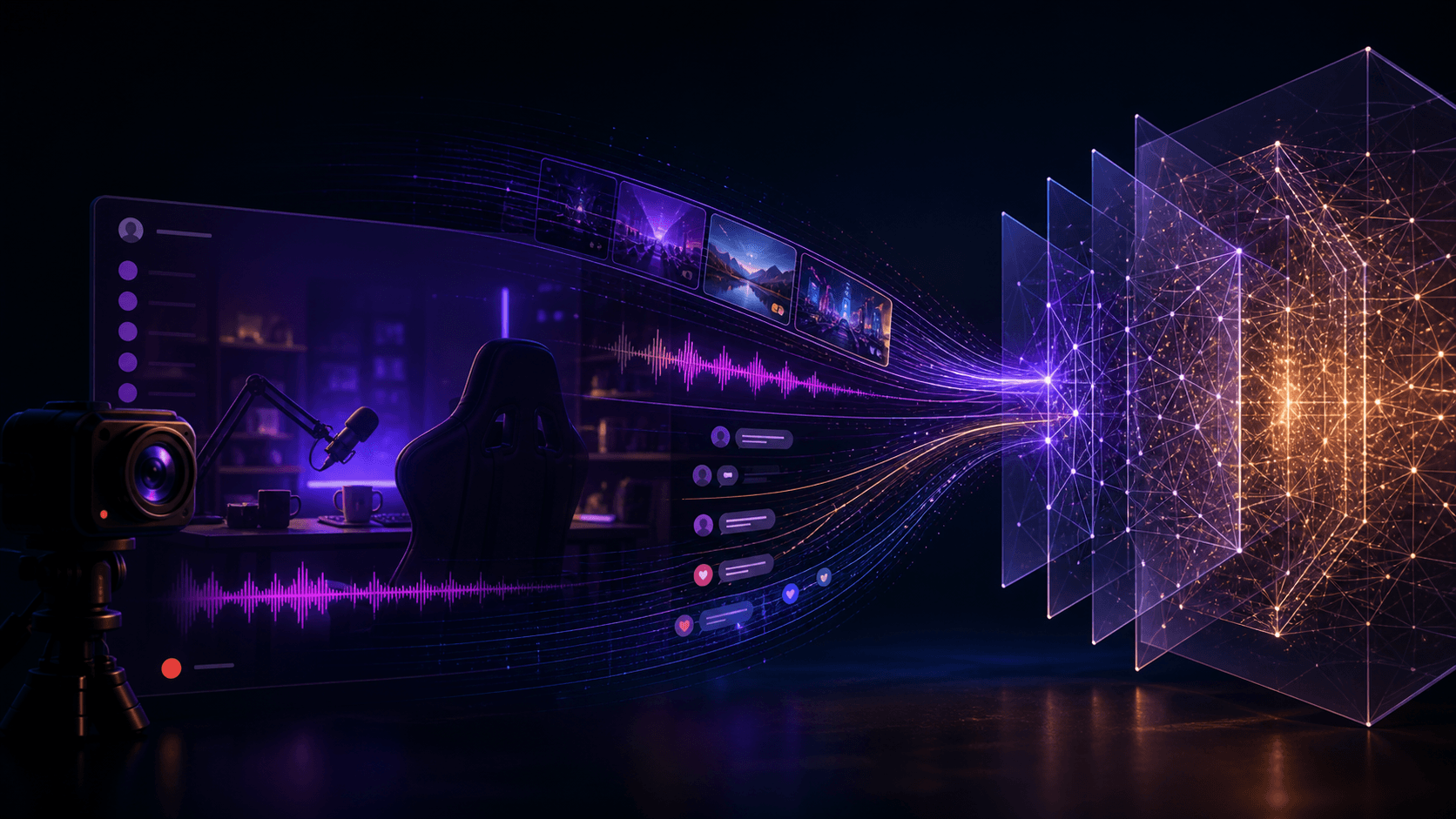
Streams, VODs, clips, chats, images and text: Twitch now lets creators refuse to have their channel content used to train Amazon's generative AI models. The problem? The setting is enabled by default. And Twitch's explanation for that choice has triggered a strong reaction from the community.
On August 12, 2026, Twitch added a new option called “Training for Generative AI” to its privacy settings.
Presented as a new control for users, the option reveals something more significant: content published on Twitch can be used to train generative artificial intelligence models developed by Amazon.
And by default, permission is enabled.
In other words, a streamer who does not change the setting may have content associated with their channel used in future training runs for models capable of generating or synthesizing text, audio, images or video.
Twitch is not asking people to participate: users must ask not to
This is probably the point drawing the most criticism.
Twitch could have chosen an opt-in system: no content would be used unless a creator explicitly agreed.
The platform chose the opposite.
The system is opt-out: training use is allowed by default, and creators must find the setting and disable it if they want to object.
Asked about that decision during the official Patch Notes show, Twitch Chief Product Officer Mike Minton gave an unusually direct answer:
“If this was opt-in, nobody would opt in.”
He then added that this was simply the real reason for the choice Twitch made.
That statement may be more important than the setting itself.
It suggests that Twitch knows a large part of its community would probably not voluntarily choose to provide content for generative model training. The platform therefore treats permission as granted until a user actively refuses it.
Mary Kish, Twitch's head of community, did not appear to expect an enthusiastic reception either. During the same presentation, she acknowledged that Twitch did not expect users to be happy or particularly supportive of the announcement.
What content can be used?
The scope is particularly broad.
When the setting remains enabled, Twitch says several types of content associated with a channel may be used to improve future Amazon generative models:
- livestreams;
- VODs;
- clips;
- Highlights;
- stream chat messages;
- images on the channel;
- text published on the channel.
The models involved are not limited to text-producing LLMs. Twitch explicitly refers to models capable of generating or synthesizing text, audio, images or video.
The platform even gives a concrete example: audio from a stream could help improve speech recognition and speech-to-text systems. Those improvements could then benefit Twitch captions as well as other Amazon products.
That makes it easier to understand why Twitch data may be especially valuable to a company developing multimodal models.
A livestream naturally combines multiple synchronized information types: voice, images, video, on-screen text, actions, streamer reactions and audience responses in chat.
It is not simply a massive collection of videos. It is a continuous flow of linked audio, visual and textual data.
The chat case is even more surprising
The way chat is handled introduces an important nuance.
Suppose you own a Twitch channel and disable the use of your content for training.
Messages written in your own chat are covered by your choice.
However, if you chat on another streamer's channel, that streamer's setting determines whether messages posted in that chat may be used.
Your own preference therefore does not necessarily follow you when you join another community.
This detail shows how complex questions of data ownership and control become on a social platform.
A message is written by one user, in another user's chat, on infrastructure owned by Twitch, which is itself owned by Amazon.
When the data is used to train AI, the seemingly simple question — “who gets to decide how this message is used?” — becomes much less obvious.
Disabling the setting does not disable all of Twitch's AI
Another important distinction: the new setting specifically concerns generative model training.
Disabling it does not mean Twitch stops all automated processing or all machine-learning use of your content.
Systems such as AutoMod, recommendations, content discovery features, safety tools and some captioning features may continue to operate. Twitch distinguishes those platform functions from using data to train models that generate new content.
That distinction matters.
Using a model to detect a potentially toxic message in chat is not the same as adding millions of messages to a corpus intended to improve a future generative model.
The new switch only disables the second category.
Amazon was already using Twitch content for AI in 2024
The August 12 announcement could make it seem as if Amazon is only now beginning to use Twitch for artificial intelligence.
That is not exactly the case.
At an event organized by The Information in 2024, Mike Minton had already confirmed that Amazon was using Twitch content in work related to model training.
He reportedly clarified that this was prototyping rather than production-scale use.
What changes in August 2026 is therefore not necessarily the beginning of Amazon's use of Twitch data.
The main change is that Twitch now provides an explicit mechanism to refuse its use in future generative training.
That is where an important grey area appears.
What happens to content that may have been used already?
Twitch uses precise wording: disabling the setting prevents the use of content for future training.
But the platform has not publicly explained:
- which Amazon models have already been trained with Twitch data;
- what categories or quantities of content were used;
- exactly when that use began;
- whether historical datasets containing the data will be deleted;
- whether opting out will have any effect on already-trained models.
Mike Minton himself reportedly said he did not know exactly what Amazon had or had not used in previous training efforts, because he was not responsible for model-training work at the Amazon level.
That is probably the issue that most urgently needs transparency.
Clicking “off” may prevent future use. It does not automatically mean that data used in the past disappears from a dataset or that its influence is removed from an already-trained model.
Twitch has announced no such mechanism.
Why Twitch data is so valuable for AI
The value of a catalogue like Twitch becomes clear when looking at the evolution of generative models.
The first major models available to the public were mostly specialized in text. New generations increasingly aim to understand text, images, audio and video at the same time, and sometimes to interact with computer environments.
For training these systems, data in which several modalities are naturally synchronized is particularly valuable.
A gaming stream can, for example, connect:
an action on screen → the streamer's vocal reaction → a facial expression → an immediate response from thousands of people in chat.
A creative stream can show a task being completed step by step while it is explained aloud.
A conversation or interview provides long sequences of spoken language with intonation, context and social reactions.
This does not mean Amazon is using all of this data in that way: the company has not published the composition of its datasets.
It does explain why a platform like Twitch could be an extremely attractive resource in the race to build multimodal models.
This is not only about copyright
For professional streamers, the question also goes beyond simple ownership of a video.
A creator gradually builds a genuine digital identity:
their voice, face, way of speaking, recurring expressions, humor, reactions and way of interacting with their community.
Those are precisely the characteristics modern generative technologies increasingly seek to reproduce or synthesize.
The debate is therefore no longer only about whether a system can learn from a video.
It raises a broader question:
how far can a platform turn the activity and digital identity of its users into raw material for future AI systems?
And who should take the initiative on consent?
The creator who wants to participate?
Or the creator who wants to refuse?
That is why Mike Minton's statement caused such a strong reaction. Saying that almost nobody would participate if the system were voluntary indirectly acknowledges that the default setting radically changes the outcome.
How to disable generative training on Twitch
Users who want to refuse this use can now disable the setting.
Go to:
Settings → Security and Privacy → Training for Generative AI
Then turn the option off.
The setting is located in Twitch account settings, not in the Creator Dashboard. A direct link is available in the resources below.
Once disabled, Twitch says channel content will not be used for future training of Amazon generative models intended to produce or synthesize text, audio, images or video.
The real debate goes far beyond Twitch
Twitch is probably just another episode in a much deeper change to the economics of the internet.
For years, major platforms accumulated enormous amounts of content mainly to distribute, recommend, moderate and monetize it through advertising.
With the arrival of generative AI, those same archives gain a new value.
A video is no longer only a video to recommend to a viewer.
It can become training data.
A conversation is no longer only an exchange between users.
It can become a language example.
A voice, image, click or reaction may potentially contribute to improving a model.
The emerging conflict is therefore not simply users versus artificial intelligence.
It is about how value created by millions of users can be reused when a platform's goals evolve.
Twitch now offers a way to refuse future use of channel content for training Amazon's generative models. That is unquestionably more control than having no setting at all.
But the fact that this control takes the form of an opt-out enabled by default, combined with the lack of information about historical use, leaves one essential question open:
when a company finds a highly valuable new use for data accumulated over years, can a user's silence really be treated as consent?
In Twitch's case, the product chief's answer at least has the merit of being exceptionally clear:
if Amazon had waited for users to voluntarily choose to participate, almost nobody would have done so.
That may be precisely why this story deserves to be followed.
Sources
- Official Twitch setting — Security and Privacy
- Twitch — Privacy Notice
- Twitch — official Patch Notes show, Mike Minton's statement and Mary Kish's comments, August 12, 2026.
- The Information — 2024 event covering the use of Twitch data for model prototyping.
- Ars Technica, TechCrunch, The Verge, Business Insider and The Register — cross-checking of the announcement, the content scope and the setting's limits.
Settings and wording may change. This article describes the documented scope of future generative training; it does not confirm that historical data has been removed from datasets or already-trained models.
Try the RouterLab API
Move from the article to a real request: start a trial, get a key, and call models through an OpenAI-compatible API.